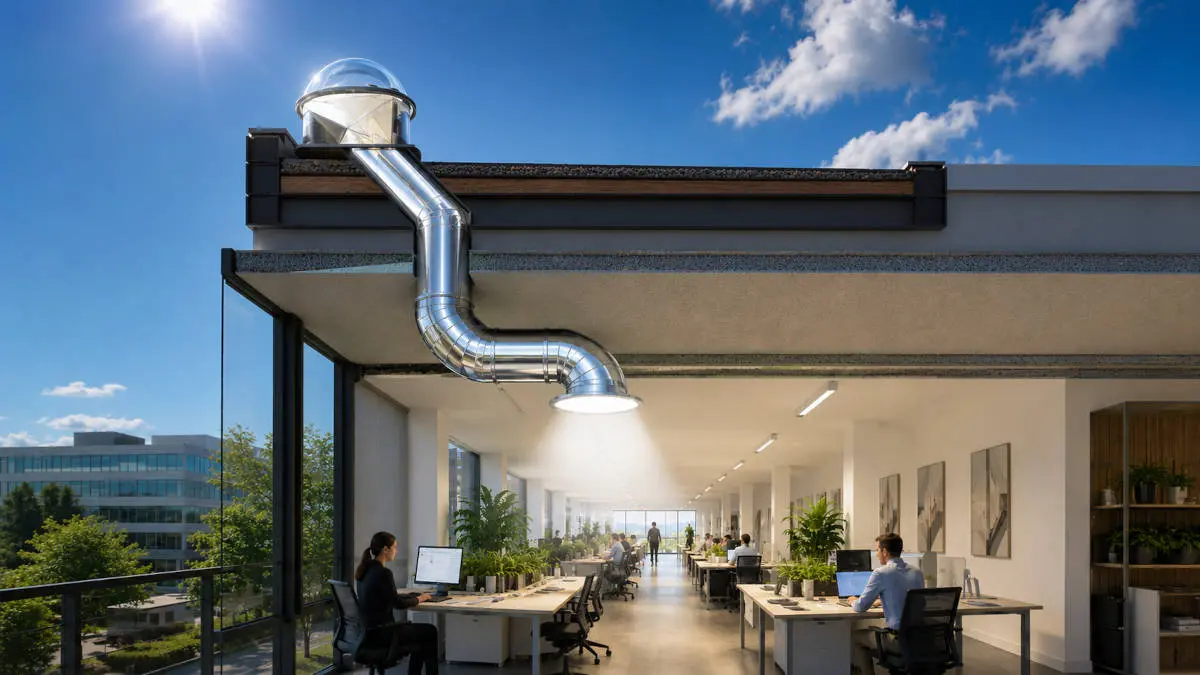
The Solatube system is described below as a representative example of so-called mirror tunnel systems, as it is one of the technologically leading tubular daylight or mirror tunnel systems. However, the fundamental principles of a mirror tunnel system can also be applied to comparable systems from other manufacturers.
Two fundamentally different approaches attempt to solve the same problem: the loss of natural daylight indoors. Human-Centered Lighting technically simulates the natural course of the day and thus remains a controlled replication of biological signals. Solatubes, on the other hand, channel real sunlight into the interior of a building, making it usable there. The difference lies not in the brightness, but in the origin of the light—simulation versus physically preserved natural dynamics within the architectural space.
Starting point: People no longer live in daylight
Modern daily life takes place predominantly indoors. Studies such as the “Indoor Generation” analyses by Velux show that people spend approximately 90–95% of their time indoors, particularly in modern societies. This represents a massive disconnect from natural light conditions, as humans are not systems independent of light. Although our internal clock is primarily genetic, it must be synchronized with an external signal—the daily cycle—otherwise we slip into a condition that, in its most extreme form, is known as NON24 sleep disorder among certain blind individuals. In this case, the sleep-wake rhythm relies solely on genetic predisposition, which is not necessarily based on a 24-hour rhythm but typically follows rhythms of up to 25 hours. The result: After 12 days, a person with NON24 is essentially living in reverse of the daily cycle.
So if this signal is missing or distorted, a gradual desynchronization occurs. Circadian synchronization is based primarily on light information processed by specialized receptors in the eye. What matters is not the subjectively perceived brightness in the traditional sense, but rather:
Indoor spaces transmit this signal only to a limited extent or in a distorted form.
The result is not necessarily acute dysfunction, but rather a lasting shift in physiological rhythms, with potential consequences for sleep quality, performance, hormonal regulation, and recovery. These processes are not shut down, but rather out of sync.
Windows are not a complete lighting system
A common misconception in architecture is equating window area with natural light.
From a physical standpoint, a clear pattern emerges: the light intensity relevant to the body’s internal clock decreases sharply as the distance from the window increases. Even just a few meters inside a room, light levels often no longer reach the thresholds necessary for a stable circadian signal.
Windows thus primarily serve two functions:
However, they are not a system designed to provide comprehensive, biologically relevant lighting throughout a room.
Human-Centered Lighting (HCL) – Controlled Simulation
Human-Centered Lighting is an attempt to compensate for this shortcoming through technology. In this approach, artificial light is designed to simulate the natural course of the day:
Benefits of HCL
Limitations of HCL
Solatubes – Physical Light Guidance Instead of Simulation
Solatubes take a fundamentally different approach. They do not attempt to imitate daylight, but rather to bring it into buildings in the most physically effective and “authentic” way possible.
The system consists of three functional components:
1. Optical light concentration at the entrance
At the entry point, daylight is focused by an optical element—typically a 180° prism—and converted into a directed beam of light.
The key point here is that the light is not merely captured, but is optically structured and concentrated even before it is transported. UV radiation, which can be problematic during prolonged exposure to sunlight, is filtered out.
2. Highly Reflective Light Transport
The light is then directed through tubular channels whose inner surfaces have extremely high reflectivity.
The following is technically relevant in this context:
Depending on the length and design, light loss is in the low single-digit percentage range. This is crucial because it does not limit its use to small roof-and-room scenarios, but rather extends it—above all—to complex building structures with large numbers of people.
3. Light distribution in the room, true daylight quality
At the exit point, the light is diffused into the room. Solatubes thus provide light that is virtually identical to natural daylight—not a simulated spectrum. Only the UV-relevant spectrum is filtered out; more on that in a moment.
In appropriate configurations, illuminance levels of over 1,000 lux can be achieved—that is, within the range relevant to circadian regulation.
Even more importantly, this light captures the natural spectral dynamics of the day:
The system thus transmits not only the intensity but also the time-dependent spectral composition of light. The body therefore interacts with the real-world lighting conditions using all of its senses.
UV filtration
When dealing with UV radiation, there is always a tension between its biological effects and potential health risks. While sunlight outdoors varies over time and can be individually regulated, this dynamic changes fundamentally indoors: Here, the issue is not brief exposures, but rather long periods of time spent by many people under constant conditions. This is precisely why UV radiation cannot be transmitted into building spaces unchanged. Solatube systems account for this fact in their design by reducing UV components as they enter through the material properties of the optics and further attenuating them along the rest of the light path. The result is not the full spectrum of sunlight, but rather specifically modified daylight designed for safe, long-term use indoors.
Controllability and Hybridization
Solatubes are by no means purely passive systems.
You can:
This results in hybrid lighting systems: Natural daylight is supplemented, dimmed, or combined depending on the situation. The difference from HCL, however, is fundamental, because the basis remains real sunlight, not a digital light simulation.
What Solatubes Can Do—and Where Their Limits Lie
Performance:
Borders:
Solatubes are not a universal lighting system, but rather an infrastructural extension of the building envelope.
HCL vs. Solatubes – Two Completely Different Approaches
A direct comparison reveals not competition, but two structurally different approaches:
| Criterion | HCL | Solatubes |
| Light source | artificial | of course |
| Principle | Simulation | physical conductivity |
| Controllability | very high | medium (hybrid possible) |
| Organic Quality | reproduced | original |
| Architecture Dependency | low | high |
| Energy Consumption | active | passive |
| System Logic | Software | Optics + Architecture |
The key difference lies not in the technology, but in the principle:
ChronoCity – Sun First
In the context of ChronoCity, the perspective on light shifts away from a mere question of illumination toward an infrastructural condition for biological synchronization. Solatubes are not merely a design detail, but rather an architectural intervention in the relationship between the building and the sun’s path: They bring real daylight into those areas that are cut off from the natural light system in traditional urban and building design. This creates, for the first time, the possibility of integrating even interior spaces into the circadian rhythm of the outside world without having to rely entirely on artificial simulation. In contrast to purely software-based lighting systems, sunlight itself remains the primary pacemaker here. Architecture is thus not only illuminated but also reconnected to the natural passage of time.
Conclusion: The real issue isn’t the light—it’s the architecture
The discussion is often reduced to lighting systems. In reality, however, the problem is architectural. HCL is a necessary solution for buildings that do not allow for sufficient integration of daylight. It is precise, controllable, and technically sophisticated, but it remains a simulation of biological reality that requires energy in the form of electricity.
Solatubes, on the other hand, shift the perspective. They bring the physics of natural light back into the interior and reduce dependence on artificial lighting controls.
This opens up a new perspective. How much genuine daylight architecture is still possible before we are forced to imitate it using technology? The starting point, then, is nature—not the possibilities offered by artificial light.
And this is precisely where it is decided whether buildings will remain living spaces or become nothing more than functional shells with optimized lighting.
Quellen
Solatube website: https://solatube.de/
Human-Centric Lighting Wikipedia: Human-Centric Lighting