ChronoClinic – what is it all about? Hospitals are meant to promote and restore health. At the same time, they are often places where the biological rhythms of both staff and patients are only partially taken into account. Early shifts start at fixed times, meal services follow organizational routines, ward rounds are scheduled according to staffing plans, and in many cases operational processes determine the daily rhythm more strongly than individual needs.
Modern chronobiology has shown for years that people do not function on the same internal schedule. Sleep, performance, concentration, recovery, and metabolism follow individual biological rhythms that do not behave identically across all individuals.
This naturally raises the question: what impact would it have if these insights were systematically integrated into everyday clinical practice?
This article uses a practical example from my project portfolio to provide an initial understanding of what that could look like in practice.
From a Presentation to a Pilot Project
The starting point for the project emerged following one of my lectures as part of an AOK Bayern event. In subsequent discussions with the management of Klinik Wartenberg (Germany/Bavaria), a visionary project approach developed that went far beyond conventional sleep consulting.
Together, the idea emerged to systematically transfer the findings of chronobiology into a hospital setting for the first time, taking into account both the perspective of staff and that of patients.
The resulting projects were scientifically monitored and designed to investigate the role biological rhythms may play in health, performance, and clinical workflows.
Why Employees Were the Focus at First
Already in the first workshop, a fundamental strategic question was raised: should a chronobiological approach start with staff or with patients? Both perspectives were discussed from the outset. However, the decision was made deliberately in favor of focusing on the staff.
The reasoning was straightforward: those who personally experience the importance of biological rhythms and integrate them into their daily work develop a much deeper understanding of their effects. Staff were not only meant to learn the principles in theory, but to experience them firsthand. This enabled them to later act as credible reference points and multipliers for patients. The patient-related component was therefore not discarded, but intentionally defined as a subsequent optional stage of development.
COPEP & ChronoClinic®: The First Field Test
This decision initially led to the “COPEP – Chronotype-Optimized Personnel Deployment and Shift Planning” project, followed by the subsequent ChronoClinic® project. These initiatives examined the effects of placing greater emphasis on individual chronotypes within work organization. More than 150 employees voluntarily had their chronotype assessed. One of the key objectives was to identify ways in which shift patterns and working hours could be better aligned with biological rhythms within existing operational constraints.
The results showed that even relatively small adjustments could have significant effects on sleep quality, daytime fatigue, concentration, illness rates, motivation, and employees’ subjective well-being. The data generated over the course of the two projects ultimately led the hospital management to formally embed the consideration of individual chronotypes into employee agreements, making it the first institution worldwide to explicitly commit to this principle and positioning itself as the first ChronoClinic® globally. The “ChronoClinic” brand has also been legally protected by Klinik Wartenberg.
These results provided a valuable basis for calculating the monetary impact in terms of cost savings.
The Next Step: Patient Management
If considering biological rhythms can already produce positive effects for staff, what possibilities might then arise for patients? Even though this question has not yet been addressed in a follow-up project, the results provide an outlook on the potential effects that corresponding measures could have within patient management.
There are several possible approaches here:
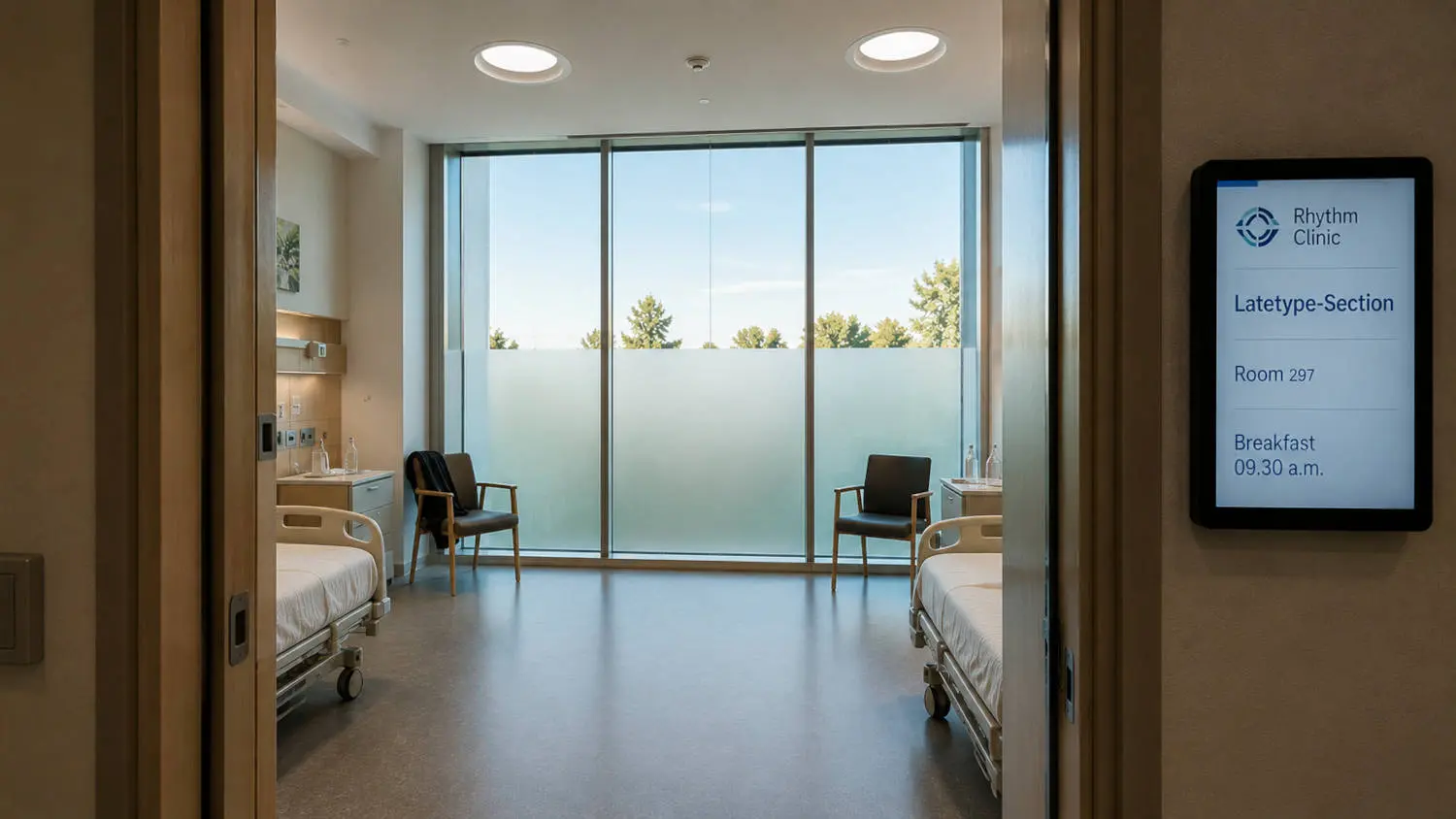
Early bird and night owl rooms: ward rounds, treatments, visiting hours, and meal times could be aligned with patients’ genetic sleep–wake rhythms. To implement this as effectively as possible, a spatial separation of early-, intermediate-, and late-type patients would be the most straightforward approach—allowing sleep, as the most important regenerative element in a hospital, to perform its function more effectively.
In addition, the entire lighting concept could be based on “Human Centric Lighting”, with artificial light being replaced by natural daylight wherever possible. Alternatively, the use of mirrored light-duct systems such as Solatube could channel daylight indoors at least when it is available. This would improve synchronization of the internal clock with the natural day–night cycle, especially in environments where regular outdoor exposure is not feasible.
The chronobiological evidence here is relatively consistent: light is the strongest external time cue (Zeitgeber No. 1) for the regulation of the suprachiasmatic nucleus. Studies show that increased daytime light intensity can improve sleep quality, mood, and activity patterns in older adults, particularly in nursing home settings.
Surgical timing: Beyond emergency procedures, elective surgeries could in the future also be scheduled in alignment with patients’ chronotypes. Current evidence on the temporal optimization of surgical interventions does not show a fully consistent picture, but it does reveal a notable pattern: the timing of surgery is not physiologically neutral. Instead, it appears to interact—at least in part—with circadian rhythms, organizational factors, and human performance capacity. Several analyses suggest that procedures performed during night or late hours may be associated with higher complication rates, while differences between morning and afternoon surgeries remain less consistent. Importantly, circadian rhythms are still largely underestimated as a structured factor within the clinical system.
The real opportunity, however, does not lie in the current state of evidence itself, but in the next stage of development: the integration of chronobiology, surgical scheduling, and individualized patient physiology. While today’s planning is primarily driven by systemic constraints such as staff availability and operating room capacity, a future-oriented approach could include biological stability, regenerative capacity, and chronotype as additional planning dimensions. A more advanced model would therefore evaluate surgical time windows not only from a logistical perspective, but also from a biological one—as part of a multimodal risk profile.
Medical treatment: Current research in chronopharmacology clearly shows that the timing of medical interventions can have measurable effects on tolerability and, in some cases, also on efficacy. Studies in oncology, starting with the work of Francis Lévi and later expanded through multiple randomized trials, demonstrate in particular a reduction in toxic side effects when drug administration is aligned with biological rhythms.
Although the overall evidence is not yet consistent enough to establish chronotherapy as a standard in clinical guidelines, it opens a broad field for innovation. A more systematic integration of chronotypes into clinical processes could represent a logical next step to reduce existing imprecision. Concepts such as ChronoClinic could go beyond timing medication alone and instead use the individual biological rhythm as a starting point—similar to how weight or renal function are already incorporated into dosing decisions today.
The potential benefit lies less in revolutionary single studies, and more in the systematic refinement of existing therapies: improved tolerability, fewer treatment discontinuations, and potentially higher efficacy through a more consistent biological fit.
New Prospects for Patients
Chronocentrically designed hospital concepts could, in the long term, enable a more precise alignment between medical interventions, therapy, patient management, and patient-specific resilience, without claiming to fundamentally replace existing standards. Even on its own, such strategic engagement creates a more solid foundation for further research.
- How can different chronotypes in patients be taken into account?
- What role do wake-up times, mealtimes, and lighting conditions play in recovery and well-being?
- What impact could individual time slots have on therapies or other medical interventions?
As already mentioned, conceivable approaches include different daily structures for early and late chronotypes, flexibly designed wake-up times, chronotype-adapted meal offerings, or, in the longer term, a stronger consideration of biological rhythms in therapeutic interventions.
The design of patient rooms could also take new directions. For example, different zones or room concepts could be developed to better accommodate the needs of early and late chronotypes.
A question with implications for the future
Ultimately, the experiences at the Wartenberg Clinic raise a fundamental question:
If we increasingly accept that humans have different biological rhythms, what consequences does this have for the design of our healthcare systems? The pilot projects conducted so far—unique in their scope internationally—do not yet provide comprehensive answers, but they do indicate that the consideration of biological rhythms could extend far beyond sleep and shift work. This may point to a largely underutilized lever for the further development of working environments, healthcare institutions, and other societal structures.
With its projects, Klinik Wartenberg has taken an initial pioneering step by not only discussing these questions on a theoretical level, but by testing them in real clinical practice—and, above all, by aiming to integrate them into long-term routines.
Sources:
Prins, A.J., de Boer, B., Milders, M.V. et al. Biodynamic lighting versus bright light effects on rest-activity rhythm and night-time sleep in nursing homes residents with dementia. BMC Geriatr 26, 620 (2026). https://doi.org/10.1186/s12877-026-07365-2
Kolberg, E.; Pallesen, S.; Hjetland, G.J.; Nordhus, I.H.; Flo-Groeneboom, E. The Effect of Bright Light Treatment on Rest–Activity Rhythms in People with Dementia: A 24-Week Cluster Randomized Controlled Trial. Clocks & Sleep 2021, 3, 449-464. https://doi.org/10.3390/clockssleep3030032
Ancoli-Israel S, Martin JL, Kripke DF, Marler M, Klauber MR. Effect of light treatment on sleep and circadian rhythms in demented nursing home patients. J Am Geriatr Soc. 2002 Feb;50(2):282-9. doi: 10.1046/j.1532-5415.2002.50060.x. PMID: 12028210; PMCID: PMC2764401.
Lévi FA, Zidani R, Vannetzel JM, Perpoint B, Focan C, Faggiuolo R, Chollet P, Garufi C, Itzhaki M, Dogliotti L, et al. Chronomodulated versus fixed-infusion-rate delivery of ambulatory chemotherapy with oxaliplatin, fluorouracil, and folinic acid (leucovorin) in patients with colorectal cancer metastases: a randomized multi-institutional trial. J Natl Cancer Inst. 1994 Nov 2;86(21):1608-17. doi: 10.1093/jnci/86.21.1608. PMID: 7932825.