Medium: El Confidencial (Spain)
Date: 27.05.2026
Format: Background article / interview + analysis
Topic: Chronobiology, urban planning, chronocity concept
Context
An in-depth expert portrait on the idea of urban development based on chronobiological principles and its potential social impact.
What it’s all about
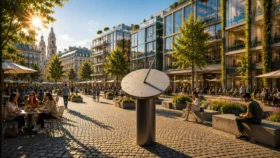
The article classifies the development of a city model based on the biological rhythms of the population. The focus is on the question of how working hours, education, infrastructure and public services would have to be rethought if the individual chronotype rather than the social rhythm formed the basis of organization.
Key topics from the article
- Transfer of chronobiology to urban and social structure
- Experiences from the Bad Kissingen pilot project
- Adapting schools, companies and healthcare systems to biological rhythms
- Tension between political feasibility and scientific logic
- Vision of a “ChronoCity” as a long-term urban model
My role in the contribution
Interview partner and concept developer of the ChronoCity and Chronobiology approaches in urban and organizational development.
Key messages
- Cities could function more efficiently if they were based on biological rhythms rather than rigid time models.
- The greatest resistance to such models is not scientific, but political and structural.
- Initial pilot approaches are proving effective, but often fail due to a lack of institutional coordination.
- In the long term, this could develop into a new urban paradigm.
Why this article is relevant
The article is one of the few international media reports that not only describes the ChronoCity concept, but also places it in a social context for the future.
Original media report
Relevant articles on the topic
- Solatubes vs. Human-Centered Lighting – Two Solutions to a Circadian Lighting Problem.
 The Solatube system is described below as a representative example of so-called mirror tunnel systems, as it is one of the technologically leading tubular daylight or mirror tunnel systems. However, the fundamental principles of a mirror tunnel system can also be…
 - ChronoCity – The Intelligent Evolution of Urban Time Structures
 ChronoCity – As part of my presentation at the international symposium “ChronoCities for a Sustainable Future” in Barcelona, where scientists, urban developers, and experts discussed the future of societal time structures, one central question once again moved into focus: What happens…
 - Starting school and work too early: How lack of sleep affects behavior and conflicts
 Starting school early can kill? September 2023 – A 15-year-old student at the middle school in Lohr shoots his classmate in the back of the head … in the schoolyard. My son knew both … perpetrator and victim. Today is Father’s…