One night, and AI tells you how sick you’ll get.
Ki, sleep & disease risk – This news reads like a disruptive development in the field of sleep research. Will we be able to make predictions about future disease risks simply by analyzing a single night’s sleep? I took a closer look at this information.
First of all, what exactly was presented? Researchers at Stanford University have developed an artificial intelligence model called SleepFM, which claims to be able to predict the subsequent risk of over 100 diseases from the data of a single night’s sleep, years before symptoms appear.
At first glance, it sounds like sci-fi medicine: a machine that takes data from a sleep measurement and uses it to create a kind of health “future prognosis”. But what is really behind it, and what does it mean for us humans?
Where the data comes from – and why it is important
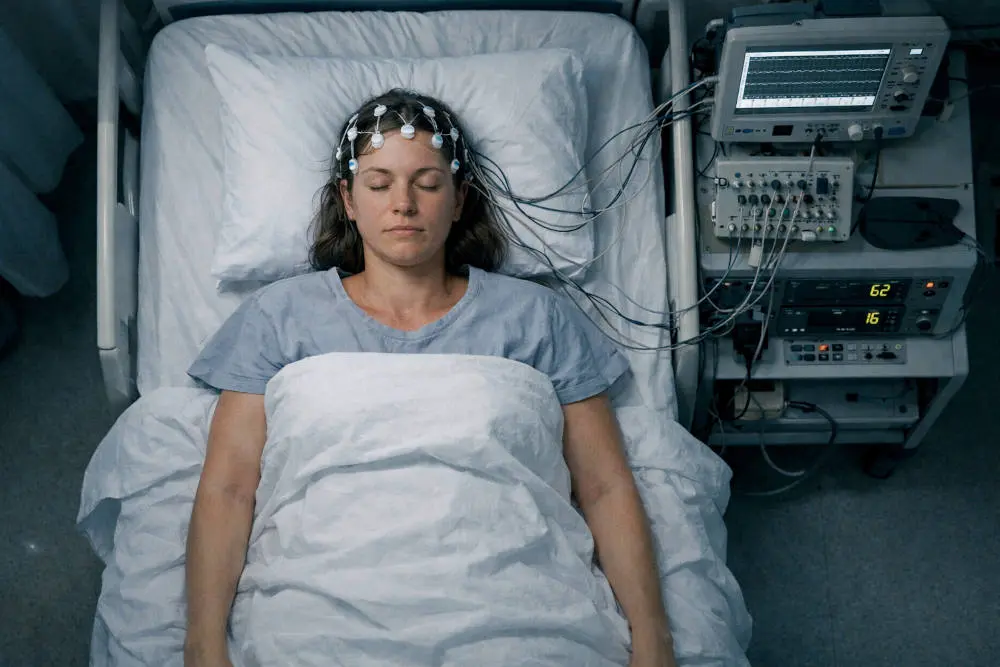
SleepFM has been trained on around 585,000 hours of sleep data from polysomnographies, the most comprehensive clinical sleep test that records brain waves, heartbeat, breathing, movements and more overnight.
Important to understand:
Polysomnography is not everyday sleep. This is a highly specialized test that is only used today in cases of suspected severe sleep disorders, typically in laboratory settings, not in everyday life. The participants knew that they were being monitored. Their sleep was “captured”, not experienced naturally. That means:
Sleep did not take place naturally, but
- in the sleep laboratory
- Wired
- monitored
- with the knowledge that you are being watched
The data was actively extracted, not passively measured in everyday life. People adapt, consciously or unconsciously, to the situation. This is not a neutral state. “Captured sleep” is therefore observed sleep under laboratory conditions, not lived sleep in everyday life.
What AI does – and how it does it
 |
 |
SleepFM uses a foundation model approach, similar to large language AI, but instead of text, the model is trained on the “language of sleep”: sequences of physiological measurements that are analyzed second by second.
The system simultaneously compares signals from the brain, heart, breathing and other channels. Where these signals are synchronous or asynchronous, they are said to indicate later risks. Researchers report that mixed patterns, such as a sleepy brain but an “alert” heart, are considered particularly meaningful.
They then link this sleep data to electronic health records that have been kept for the same people over decades. On this basis, the model has learned which combinations of data later led to which diagnoses.
What SleepFM can supposedly do – and how good it is
Some of the results are impressive:
- Parkinson’s risk: C-index ~0.89
- Dementia: ~0.85
- Heart attack: ~0.81
- Certain types of cancer: up to ~0.89
- Total mortality: ~0.84
The C-index is a statistical measure of how well a model distinguishes between “higher” and “lower” risk. A value of 0.5 corresponds to chance; over 0.8 is considered relatively strong. However, this does not mean that the model predicts a diagnosis with certainty; it can classify relative risks.
Even here you have to be careful: A good ranking does not automatically mean clinical relevance. The decisive question is not just whether a risk is higher or lower, but what can be done with it in practice.
AI, sleep & disease risk – what does this change for patients?
This is where things get more complex.
1. data source versus reality
The data comes from clinical laboratory environments. A single sleep in the laboratory may say little about the reality of sleep at home, in familiar surroundings, without sensors, without doctors in the room.
2. risk vs. diagnosis
The model assigns a statistical risk. It is not a diagnostic tool. If SleepFM says that someone has an increased risk of dementia, this does not mean that the person has dementia or will necessarily develop it.
3. translation into measures
What should a doctor do if the model indicates an increased risk but there are no clinical symptoms? Treat earlier? Encourage overdiagnosis? Put patients in unnecessary fear? These are real risks that should not be defined away. We are familiar with the risk of a “self-fulfilling prophecy” from statements such as “You have x days to live!”. After every prediction, life turns out differently than before. Theoretically, the AI would have to incorporate this assumption into a prediction model, but this is extremely complex.
4. bias and generalizability
Such AI models learn from historical data. What if certain population groups are underrepresented, or if the patterns that appear striking today simply reflect random correlations? Retrospective models tend to “see” things that are often less stable in prospective, real-world applications.
The question of clinical application
Some researchers see this as a milestone for preventive medicine, an opportunity to recognize health risks earlier and intervene.
I remain skeptical (as always):
- Firstly, there is a huge difference between prediction in historical data and reliable application in the real world.
- Secondly, we do not know whether such risk predictions lead to better health outcomes. It is one thing to predict risks; it is another to derive effective, harmless measures from them.
Both must first be validated prospectively and independently before patients are informed or even treated prophylactically on this basis.
Conclusion – exciting, but read with cautious optimism
Theoretically, this approach has enormous potential for primary prevention. In reality, however, the risk potential for abuse through the development of drug prophylaxis is at least as great. In other words, there is a huge field in which (still) healthy people can be drawn to drug addiction at an early stage.
Two aspects should be observed in this context.
- The study was funded by Mark Zuckerberg’s Chan-Zuckerberg Biohub, a non-profit research organization with the overarching goal of achieving biomedical breakthroughs through interdisciplinary collaboration. I am writing this here in a completely non-judgmental way, but this AI-based prognosis topic fits in with the longevity thrust, e.g. in embryo scans (my article “Longevity embryos”).
- The AI only works if the patient history is available, i.e. sensitive data that could be used to determine the amount of health insurance premiums, for example. Such studies are not financed privately of their own free will, because if a business model develops from this, which is based on the prognosis, so to speak, nothing stands in the way of the patient being constantly bombarded by corresponding providers. It can become very worrying if health insurance companies prescribe appropriate drug “prophylaxis” in order to keep premiums low.
Not a gloomy prognosis, just mind games on my part.
It is undeniable: Stanford has presented an AI model that uses sleep data in a way that goes far beyond traditional sleep diagnostics. The idea of extracting deeper physiological patterns from raw measurements beyond duration and interruptions is fascinating.
AI, sleep & disease risk summarized:
- We are talking about retrospective risks, not confirmed diagnoses.
- The database comes from laboratory environments, not from everyday life.
- No one has shown that people with these risk scores get better care or stay healthier longer.
- Any business models that develop from this should also be viewed critically by politicians.
In short: an interesting research tool with great potential for both prevention and manipulation.
Interesse an mehr (kritischen) Themen zu Schlaf und Chronobiologie? Abonniert gerne meine „ChronoCoach-Update“.
Sources:
https://news.stanford.edu/stories/2026/01/ai-model-sleep-disease-risk-research-sleepfm
https://scitechdaily.com/stanfords-ai-predicts-disease-risk-from-a-single-night-of-sleep

