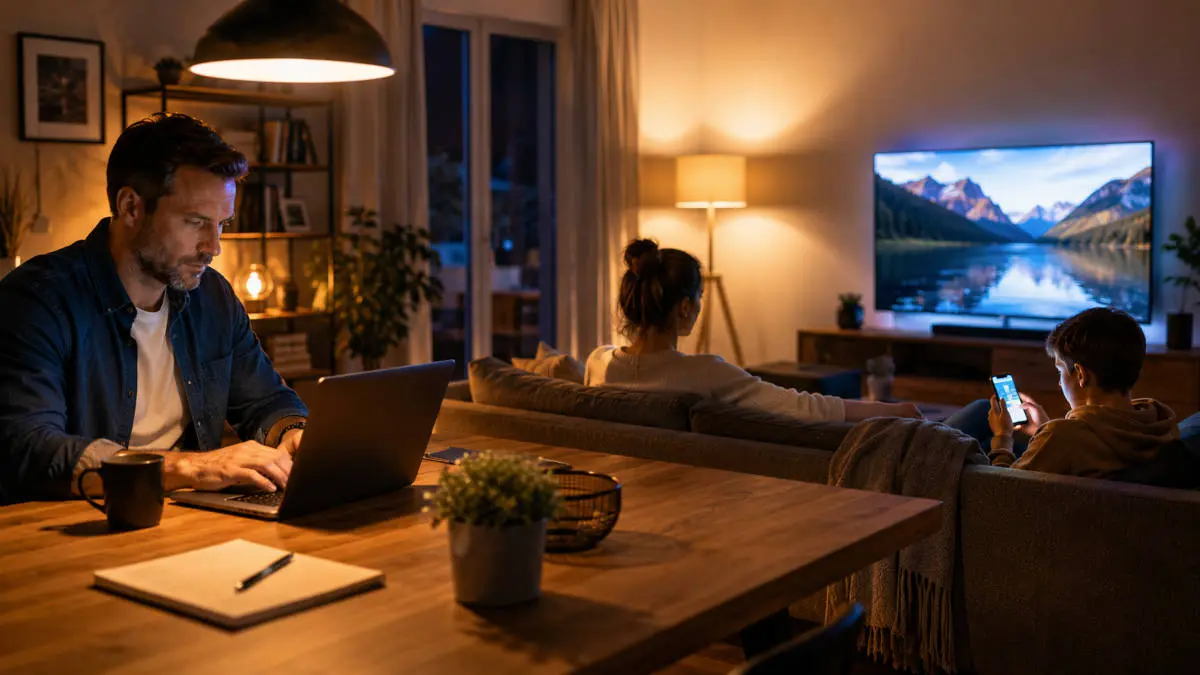
For years, we’ve been hearing the same message: screens in the evening disrupt sleep. The main culprit is blue light, which inhibits the release of melatonin and thus makes it harder to fall asleep.
But everyone has noticed something that doesn’t quite fit with this explanation. Millions of people regularly fall asleep in front of the TV. How can that be? Isn’t that exactly what the TV is supposed to prevent?
Perhaps the real question isn’t whether we’re sitting in front of a screen, but which one.
Not all screens are the same
Televisions, laptops, and smartphones are often lumped together. From a biological perspective, however, they differ significantly. The key factor here is not just the light itself, but the interplay of various factors.
These include, among other things:
- the amount of light that actually reaches the eye,
- the distance from the screen,
- mental and emotional stimulation,
- the sleep pressure that has already built up,
- as well as posture and the surroundings.
It is the interplay of these factors that determines whether we stay awake or fall asleep.
Television: Surprisingly Harmless?
At first glance, a large TV appears brighter than a smartphone. In fact, the retina is often exposed to significantly less light.
The reason is simple: The TV is usually several meters away. As the distance increases, the amount of light reaching the eye decreases significantly. Although the image appears bright subjectively, the retina often receives only a fraction of the light that a smartphone, for example, emits at close range. Added to this is the way the TV is used.
Watching TV is mostly a passive activity. We sit or lie back on the sofa, move very little, and consume content without having to constantly make decisions or react. At the same time, the urge to sleep is usually already strong in the evening. Under these conditions, the brain can easily drift off to sleep despite a bright screen.
It’s not uncommon for habit to play a role as well. Anyone who regularly falls asleep on the sofa over the course of years subconsciously associates that place with tiredness and sleep.

The Laptop: A Temporary Solution
A laptop is positioned much closer to the eyes. As a result, the light exposure is greater than with a TV. Above all, however, it is often used in different ways. We write emails, do research, work on presentations, or solve problems. The brain remains active. Even if the brightness is moderate, this mental stimulation can make it harder to fall asleep.
Of course, there are exceptions. If you’re watching a quiet movie on your laptop, the experience is similar to watching TV. If, on the other hand, you’re working right up until bedtime, you’re exposing your brain to a completely different set of stimuli.
The smartphone: small, but biologically effective
Smartphones combine several factors that can make it difficult to fall asleep. They’re usually held just 20 to 30 centimeters in front of your face. As a result, significantly more light reaches the retina than with a television. Added to this is the intense interaction. Replying to messages, scrolling through social media, reading comments, or switching between videos—all of this keeps the brain active.
Added to this are emotional stimuli. An unexpected message, a heated discussion, or engaging content can significantly increase the level of arousal within a matter of seconds.
It would therefore be too simplistic to attribute the smartphone’s effect solely to blue light. Often, it is the combination of close proximity, high light intensity, constant interaction, and emotional arousal that makes it difficult to fall asleep.
Perhaps we’ve been discussing this in too one-sided a way for years
Public discussion often centers on a single term: emergency lights.
However, melatonin is just one of several factors that influence our sleep. Just as important are sleep drive, mental arousal, body temperature, emotional arousal, and our individual habits.
Anyone who focuses exclusively on emergency vehicles may be overlooking a large part of the bigger picture.
Conclusion
Televisions, laptops, and smartphones are not biologically equivalent devices.
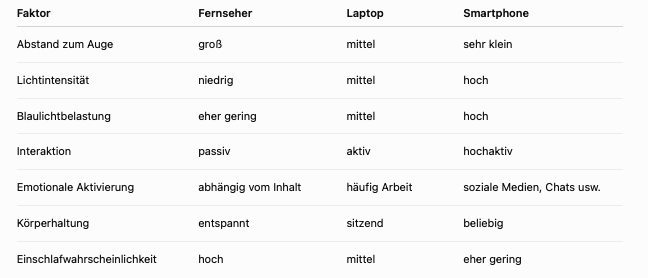
A television is usually viewed from a greater distance and used primarily passively. A laptop often falls somewhere in the middle in terms of viewing distance and usage. A smartphone, on the other hand, often combines several factors that can negatively affect sleep: close proximity to the eye, higher light intensity on the retina, and intense, often emotionally charged interaction.
However, it is not just the device itself that matters. A modern smart TV can also be used for scrolling through social media, chatting, or playing online games. In such situations, it is not only the nature of the use that changes, but often the biological effects as well. Interaction, emotional engagement, and sustained attention then come more to the fore—factors we otherwise tend to associate with smartphones.
Perhaps that’s why we should stop asking whether screens disrupt sleep.
The more interesting question is:
Which characteristics of a screen—and, above all, how we use it—actually affect our sleep?
After all, it may not be screen size alone that determines the quality of our sleep, but rather the interplay of light, distance, stimulation, and usage patterns.

