Healthy work – everyone talks about it, but nobody knows what it is, because many discussions about “healthy work” are only on the surface. They start with stress, working hours or mental strain. They point out the consequences of unhealthy work, similar to unhealthy nutrition, lifestyle, etc., back them up with studies and then make suggestions on how to reduce these consequences. But this does not describe healthy work.
As a result of this way of thinking, I have not yet come across a single approach that describes “healthy work” without expressing it in terms of the elimination of elements that cause illness. In other words: “Healthy work is work that doesn’t cause this and that!”
What’s more, everyone who deals with healthy work does not define “healthy”. In all discussions about this on LinkedIn, I ask the question: “What is health?” I usually only get silence.
My assertions: Nobody knows what healthy work actually is because it doesn’t exist … at least not in our society.
Theoretically, however, it does exist.
Starting point “Definition of health”
I have written a lot about what health means to me, and it has nothing to do with the WHO definition from 1948, but is simple:
“Health is the maximum self-regulating capacity of an organism – without dependence on external, artificial interventions.”
Healthy is therefore anything that actively supports this ability to self-regulate. Based on this, the definition of illness is logical.
“Illness is a condition in which self-regulation is blocked and external interventions become necessary.”
Health is therefore a mandatory no-medication status, everything else is pointless.
The crucial question is therefore not how we can make people more resilient to modern work, but rather how compatible modern work is with human biology if it can and is allowed to act in a healthy way in the sense of the above definition (self-regulation ability). If we look at people not primarily as an economic resource, but as a biological system, a different view of “work” suddenly emerges. Let’s take a closer look:
Core elements of the ability to self-regulate
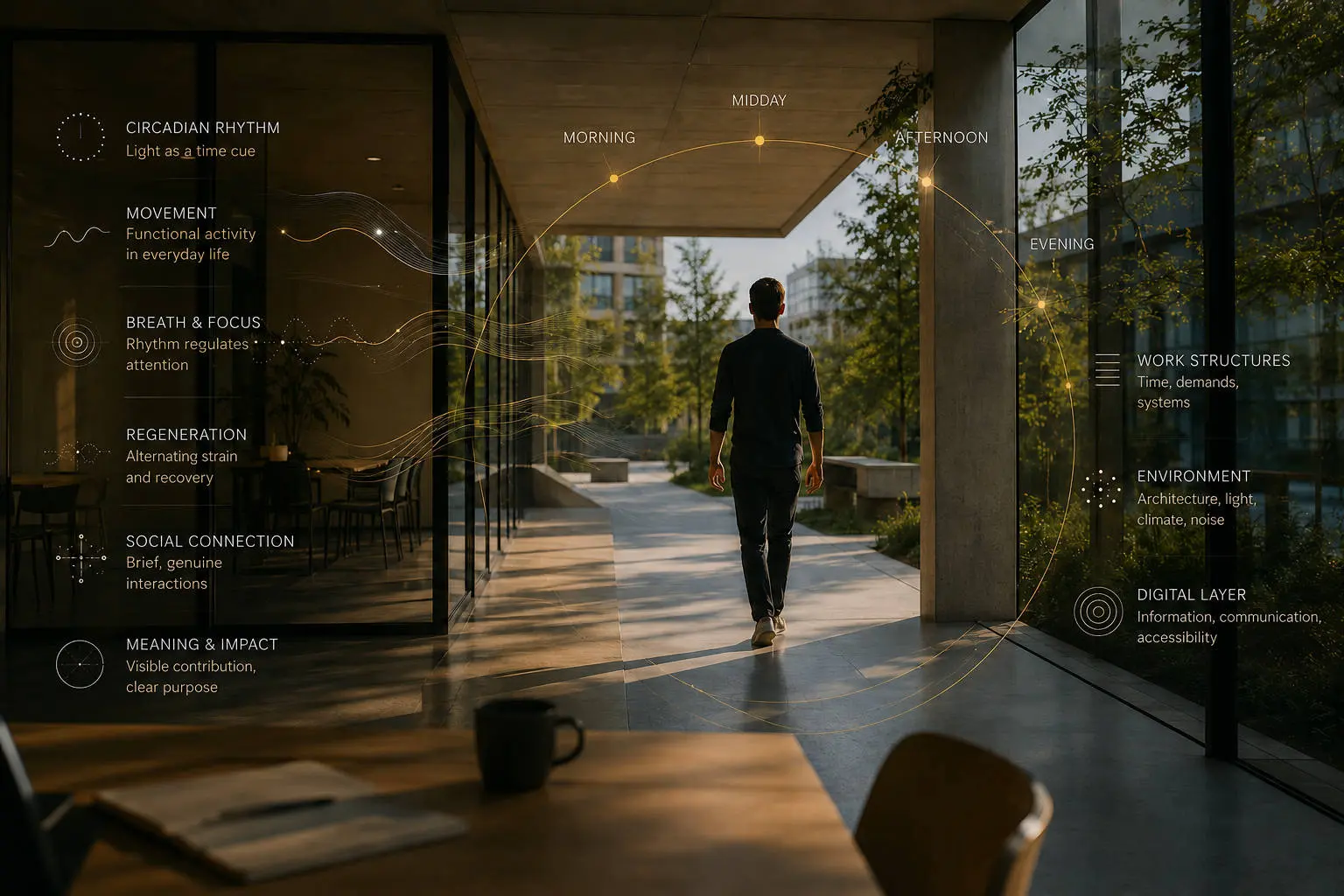
Humans are not static beings. In evolutionary terms, they are designed for movement, daylight, social dynamics, genetic rhythm and regeneration. However, it is precisely these factors that are increasingly disappearing from modern working environments. Instead, long periods of sitting, artificial light, rigid time structures, screen work and permanent mental overstimulation dominate. Up to a certain point, self-regulation can take effect here, but as soon as it has to take effect at all, work is no longer healthy, but at best not harmful, as long as this self-regulation is not overwhelmed.
The paradox is that many people today are both mentally exhausted and physically underchallenged. This sounds contradictory at first, but from a biological point of view it is logical. While the body often experiences hardly any natural movement for hours on end, the brain is constantly burdened with information, context changes, interruptions and artificial urgencies. The result is often a chronic dysregulation of attention, sleep, regeneration and energy levels.
It’s like a Ferrari that revs higher and higher when stationary, but doesn’t move an inch.
This is precisely why the traditional discussion about “healthy work” often falls short. Ergonomic chairs, fruit baskets or yoga classes do not automatically change the fundamental structure of work itself. They do not make work healthier, but are more of a “green of shame” in front of a concrete skyscraper.

And my absolute WOW effect was the ChronoCoach®
training.I’ve often thought: “How cool that this is included, and what a shame that so few people know about it yet!”

Underestimated biology – example chronotype
Perhaps we need to start looking at work not just psychologically, but biologically.
This does not mean that psychological factors are unimportant, on the contrary. Meaning, belonging, autonomy and appreciation play an enormous role. But even highly motivated people can work biologically against their own design in the long term if they do unhealthy work.
This is particularly evident when it comes to chronotype.
People have different biological sleep-wake rhythms. Some are able to work early, others much later. These differences are not a weakness of character, a lack of discipline or a fad, but a chronobiological reality.
Despite this, many working models are still based on a largely rigid ideal of time. Starting early is often still seen as performance-oriented, even though studies have shown for years that working against your own biological rhythm can have a significant impact on sleep quality, regeneration, concentration, metabolism and mental stability. I don’t even want to talk about shift work here.
Healthy work is only work that supports the “human” system.
The interesting thing is that companies can already influence this today and benefit massively from it at the same time. We have already proven this in our scientifically supported pilot projects. Flexible working hours are often discussed primarily in terms of employee satisfaction. But from a chronobiological perspective, it could be about much more: biological compatibility.
An employee who constantly works against their chronotype often needs more energy to compensate:
- more coffee,
- more willpower,
- more mental self-regulation,
- more nutrients.
Addictions such as sugar consumption, energy drinks etc. accelerate the negative development. The problem is that many companies do not (want to?) see these costs directly. They do not immediately appear causally in key figures because there are hardly any key figures for them. Instead, they show up gradually:
- sinking energy,
- Concentration problems,
- higher susceptibility to errors,
- inner exhaustion,
- reduced motivation,
- long-term health problems.
This has a massive impact on absenteeism, the error rate and staff turnover. It is not a question of completely adapting every working environment to individual needs. That would be neither realistic nor always sensible. It’s about discussing what works, not what doesn’t. That’s why the question should be legitimate:
How much of today’s work is based on genuine human function, and how much on historically evolved efficiency models?
Many modern structures were not developed on the basis of biological findings, but from industrial requirements:
- Synchronization,
- Control,
- Standardization,
- Planning capability,
- maximum availability.
This may also explain why some working environments feel subjectively more and more unnatural despite increasing comfort.
Healthy work is not always pleasant work
Interestingly, “healthy work” does not automatically mean “pleasant work”. Physical or mental stress is not fundamentally negative. People need challenges, activation and even stress in order to develop. Rather, the decisive factor is whether stress occurs within biological regulatory capacity or works permanently against it.
A mountain guide can be under a lot of physical strain and still feel healthier than a permanently sedentary knowledge worker with permanently fragmented attention. Not because movement alone automatically makes you healthy, but because the overall structure of the activity can be closer to basic human functions.
This is precisely where a new understanding of work could emerge in the future.
Old question: “How do we make work more efficient?”
New question: “How do we design work in such a way that biological potential is preserved in the long term?”
That would change the discussion:
- away from pure performance optimization,
- towards biological sustainability.
Chronotypes are just one example. Similar questions arise in relation to movement, light, regeneration, attention, social dynamics and permanent digital accessibility.
Necessary change of perspective
So what is healthy work, does it really not exist? The closest thing to healthy work, based on the self-regulation definition of health, is a job that will probably soon no longer exist. The letter carrier … if he/she is a genetic early type.
He/she moves a lot, is out in the fresh air in all weathers, the exercise is varied, there is moderate social contact. The work itself, if it is not torpedoed by a poor diet or lifestyle, supports the immune system. Of course, the nature of the work can also lead to negative influences, but these do not lie in the basic function of the job, but in its implementation.
Perhaps the future of healthy work therefore lies not just in new benefits or wellness programs, but in a fundamental change of perspective:
Humans are not machines that simply need to be kept efficient. They are a biological system with natural rhythms, limits and regulatory mechanisms. These biological rhythms are not up for discussion, they are the basis.
And the more modern work works permanently against this construction, the more energy is needed to keep the human system functioning at all.
There are solutions, and they pay for themselves in a very short time. You just have to want it!