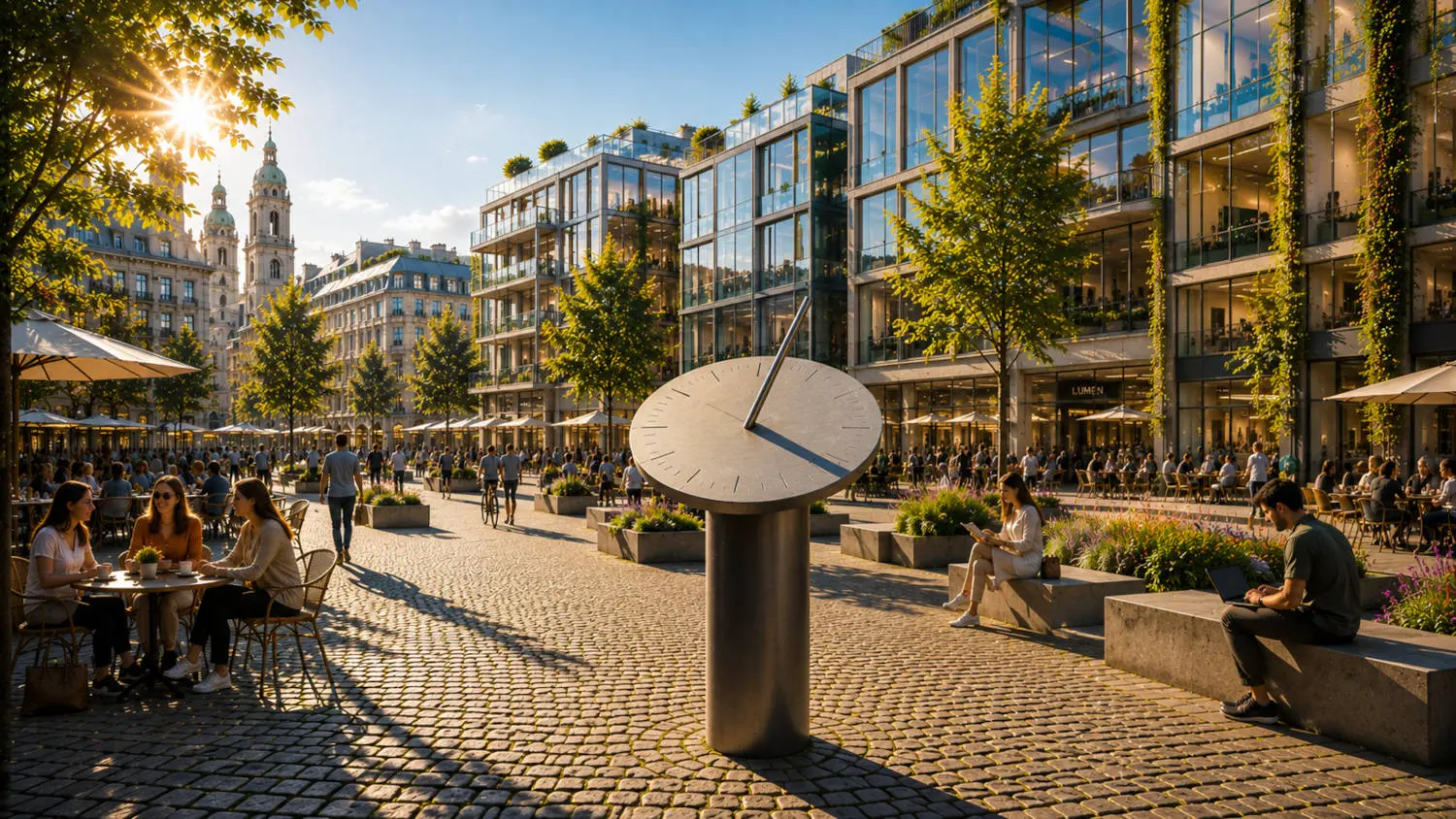
ChronoCity – As part of my presentation at the international symposium “ChronoCities for a Sustainable Future” in Barcelona, where scientists, urban developers, and experts discussed the future of societal time structures, one central question once again moved into focus:
What happens when modern societies continuously evolve their technological systems while still largely ignoring the biological rhythms of human beings?
The discussions surrounding chronobiology, urban development, and work organization also led to an extensive interview with me in the Spanish newspaper El Confidencial about the concept of the “ChronoCity” — the idea of a city that no longer treats biological time structures merely as an individual health issue, but as a strategic component of work, education, infrastructure, and societal stability.
The following article explores the background of this development, insights gained from initial pilot projects, and why chronobiological time structures may become far more than a niche topic within health research in the future — potentially evolving into a key factor for more resilient societies in an age of increasing technological and mental overload.

The idea of ChronoCity was born back in 2003. When I first began studying chronobiology intensively more than twenty years ago, the subject was almost impossible for 99.9% of people to grasp. How I arrived at this field is a story of its own, which can be read here.
At the time, sleep was considered a private matter, mental exhaustion an individual weakness, and differences in performance patterns were often treated as character traits. Those who functioned well early in the morning were seen as disciplined, while people who became productive later in the day were quickly labeled unstructured or lazy.
The idea that biological rhythms are deeply embedded within us and directly influence health, performance, and even societal processes played almost no role in public discourse back then — partly because many chronobiological mechanisms were still poorly understood scientifically.
ChronoCities – Intelligent Questions Lead to Intelligent Answers?
Back in 2002, I began asking myself several questions for the first time:
- Why do all people live according to the same time structures if human beings function biologically differently?
- Why do schools begin at times when part of the student population is biologically not yet capable of peak performance?
- Why are working hours still often based on historical industrial processes instead of human biology?
- Why are people considered “high performers” simply because they function early in the morning, even if their bodies may permanently operate against their own natural rhythm?
- And what are the long-term consequences for health, the nervous system, relationships, and society when millions of people continuously live against their internal time?
- What economic damage does this create?
From these questions, the topic never became merely “about sleep” for me. It became an entirely new perspective on work, daily life, and societal organization.
To me, chronobiology means far more than sleep schedules or whether someone is an early bird or a night owl. It describes the biological rhythms of the human body, influenced by light, hormones, metabolism, temperature, and genetic predisposition. The body does not recognize clock time in the human sense. It recognizes rhythms.
And this, in my view, is where one of the greatest problems of modern societies begins. Human beings are biologically organized around rhythms, while society imposes an artificial system of timing.
Overwhelming Relevance
According to a Rand Europe Study sleep deprivation costs the German economy around €60 billion annually — nearly 70 billion USD — while the economic loss projected for the United States by 2030 approaches 470 billion USD. A silent pandemic that has already spread throughout society.
Today, many people intuitively sense that something is wrong, even if they cannot fully articulate it. And this is not merely about classical stress. The body does not separate sleep deprivation, time pressure, permanent availability, artificial light exposure, social expectations, and lack of recovery into isolated categories. The nervous system does not clearly distinguish between emotional stress, sleep deficit, or biological misalignment. For the body, these factors often merge into a permanent state of internal alertness. Entire libraries of studies exist on this topic.
Chronobiology, however, is NOT simply about sleep. It focuses on the genetically influenced 24-hour sleep-wake rhythm — and people differ dramatically in this regard. In one of our projects involving 138 participants, the difference between the earliest chronotype and the latest exceeded 13.5 hours. An enormous potential societal time bomb.
This is precisely why I never viewed chronobiology as an isolated health topic, but always as a societal issue.
The core question is:
Why are we constantly trying to adapt human beings to rigid systems instead of adapting systems more intelligently to human biology?
ChronoCity – An Overdue Project Initiated Too Early?
This way of thinking eventually evolved into the vision of the ChronoCity.
The idea of a city in which companies, schools, transportation systems, public institutions, and societal processes are not organized solely around economic efficiency, but also around biological reality.
This was never about allowing everyone to live completely freely according to their own rhythm, nor about dissolving societal order. Quite the opposite. For me, it was always about creating more intelligent systems.
Because a person who permanently lives against their internal clock does not automatically become more productive. In many cases, they become more exhausted, irritable, error-prone, and, over time, biologically unstable. The consequences affect not only individuals, but also families, companies, healthcare systems, and ultimately entire societies.
Between 2012 and 2016, I had the opportunity to implement parts of this vision more concretely in Bad Kissingen. Together with scientific partners, projects were launched in schools, companies, and healthcare environments. Student chronotypes were analyzed, school schedules adjusted, work-time models reconsidered, and health-related correlations examined. At the time, many of these ideas were far ahead of public discourse — and perhaps for that reason, media interest was greater than the patience of political stakeholders.
Today, however, these concepts suddenly appear far more tangible.
Especially after the societal changes of recent years, more and more people have started questioning existing time structures. Home office culture, burnout, chronic exhaustion, sleep disorders, and psychological overload have made one thing increasingly visible:
Productivity alone is not a stable foundation for healthy societies.
More and more people are beginning to realize that human beings are not linear systems.
They require rhythms, recovery, phases of activity and rest — particularly in a world where the competition for human attention never pauses for a single second. What is missing are societal structures that no longer permanently ignore biological reality.
This is exactly why I do not see chronobiology as a niche subject for sleep experts, but rather as a possible next evolutionary step for modern societies.
ChronoCity – What Is It at Its Core?
At its strategic core, a ChronoCity integrates human biological rhythms and the resulting conscious time policies into long-term urban development.
This applies to:
- Schools — particularly regarding school start times, examination schedules, and the integration of chronobiological knowledge into education.
- Employers — who take employees’ genetic rhythm structures into account when planning working hours, shift systems, meetings, and even cafeteria schedules.
- Hospitals and healthcare systems — recognizing that ignoring the biological clocks of both staff and patients can reduce or even undermine treatment and therapy outcomes.
- Social interaction — because sleep deprivation and biological misalignment significantly increase aggression and social instability.
These are merely examples illustrating the strategic dimensions of a ChronoCity.
A core principle is that ChronoCity is not designed as a temporary project with an expiration date, but as a permanent strategic element of urban development. This means the process must be institutionally anchored either within city administration itself or through an external organizational structure capable of coordinating and expanding stakeholder collaboration.
An important realization is that this is not about overturning society overnight. It is about applying the Pareto principle and identifying the 20% of chronobiological leverage points capable of generating 80% of the positive effects.
I would like to briefly illustrate this using one of our projects.
Waking Up Without an Alarm Clock
In 2019, we launched a scientifically supervised project within a medium-sized company. The goal was simple: for three months, 12 volunteer employees were officially allowed to sleep as long as they needed. It was entirely up to them when they arrived at work.
The effects on health and performance were remarkable even within this relatively short period. But for the company, one particular effect proved especially interesting: almost no structural reorganization was required.
Most participants simply began using the flexible working hours that had already existed before. Previously, however, there had been a psychological barrier — people did not want to be perceived as “lazy sleepers.” As a result, many late chronotypes still started work early despite functioning poorly at those hours.
The project changed this dynamic. Employees were no longer labeled as lazy once people understood that genetic chronotypes were involved. They simply arrived later, used the existing flexibility, and the company itself had to change virtually nothing structurally.
This example demonstrates how enormously effective intelligently positioned pilot projects can be without generating resistance. And this principle lies at the very heart of strategic ChronoCity development.
ChronoCity as an Intelligent Corrective to Modern Smart City Development
Today, many cities are investing heavily in Smart City and digitalization projects. The goal is to make cities more efficient, connected, and technologically capable. This development is important and will continue to accelerate.
At the same time, however, a new challenge is emerging:
The more complex digital systems become, the greater the demand for resources, organizational effort, and adaptation pressure within municipal structures.
In addition, technological innovation cycles are now progressing faster than many municipal decision-making, implementation, and amortization processes.
As a result, cities increasingly face a structural risk:
The speed of technological development forces digital project cycles to become shorter and shorter in order to remain economically viable. This makes organizational stability, societal acceptance, and long-term economic predictability increasingly difficult — particularly given the long lead times of municipal decision-making processes.
ChronoCity therefore does not position itself as an alternative to the Smart City concept, but rather as a necessary parallel development designed to prevent the human factor — and the enormous economic and organizational costs connected to it — from becoming destabilized.
While Smart City concepts primarily optimize technological systems digitally, ChronoCity additionally integrates the biological and societal realities of human beings into urban development in order to unlock human potential as efficiently as possible and minimize friction between external demands and biological functioning.
This creates a second layer of development:
Not only technological progress, but also human stability, societal regeneration, and sustainable organizational resilience capable of biologically supporting long-term technological advancement.
Technology that supports human biology instead of permanently overwhelming it ultimately requires fewer compensatory resources — medically, organizationally, and socially.
The future of modern cities may ultimately depend not on how intelligent technology becomes, but on how intelligently we connect technology with human biology.
