A Position Paper on Integrating Chronobiological Aspects into Workplace Risk Assessments
Status Quo
Chronobiological Safety Compliance – Companies invest significant resources in occupational health and safety. Risk assessments cover physical stressors, ergonomic factors, psychological stress, noise, hazardous substances, and organizational risks. The goal is to identify potential hazards early on and develop appropriate protective measures.
This approach has significantly advanced occupational safety and health over the past few decades. At the same time, however, a fundamental question arises:
A question that has received little attention so far
Every job is performed by people, and people do not follow organizational guidelines exclusively, but primarily biological laws.
In companies, work schedules are primarily planned based on organizational, economic, or labor law considerations. The underlying assumption is usually that identical work schedules create comparable conditions for all employees.
Modern chronobiology, however, paints a different picture. People differ in their internal biological rhythms. While some people reach their peak performance and concentration levels as early as the morning hours, others achieve their highest cognitive performance significantly later in the day. If these biological differences are consistently ignored, they can significantly affect attention, decision-making quality, recovery, and long-term resilience.
The key question, therefore, is not only whether working hours are organized efficiently, but also whether, under certain conditions, they themselves can become a previously unconsidered safety risk.
Chronobiology as the Missing Link
Chronobiology studies the genetic and biological rhythms of humans and their influence on biological functions, as well as the associated effects on social organization and processes. Many of its findings have been thoroughly researched and are already being applied in fields such as sleep medicine, shift work, and light research.
So far, however, these findings have been linked only to a limited extent with existing occupational safety systems. The concept of chronobiological safety compliance addresses precisely this intersection. It raises the question of whether chronobiological mismatches should be considered a separate risk factor in workplace hazard assessments in the future.
A Catalyst for Professional Discourse
This position paper is expressly not intended to be a definitive answer, but rather an invitation to interdisciplinary dialogue.
It is intended for professionals in the fields of occupational safety and health, occupational medicine, chronobiology, human resources, workplace health management, and corporate management, as well as for institutions and policymakers involved in further developing existing occupational safety and health systems.
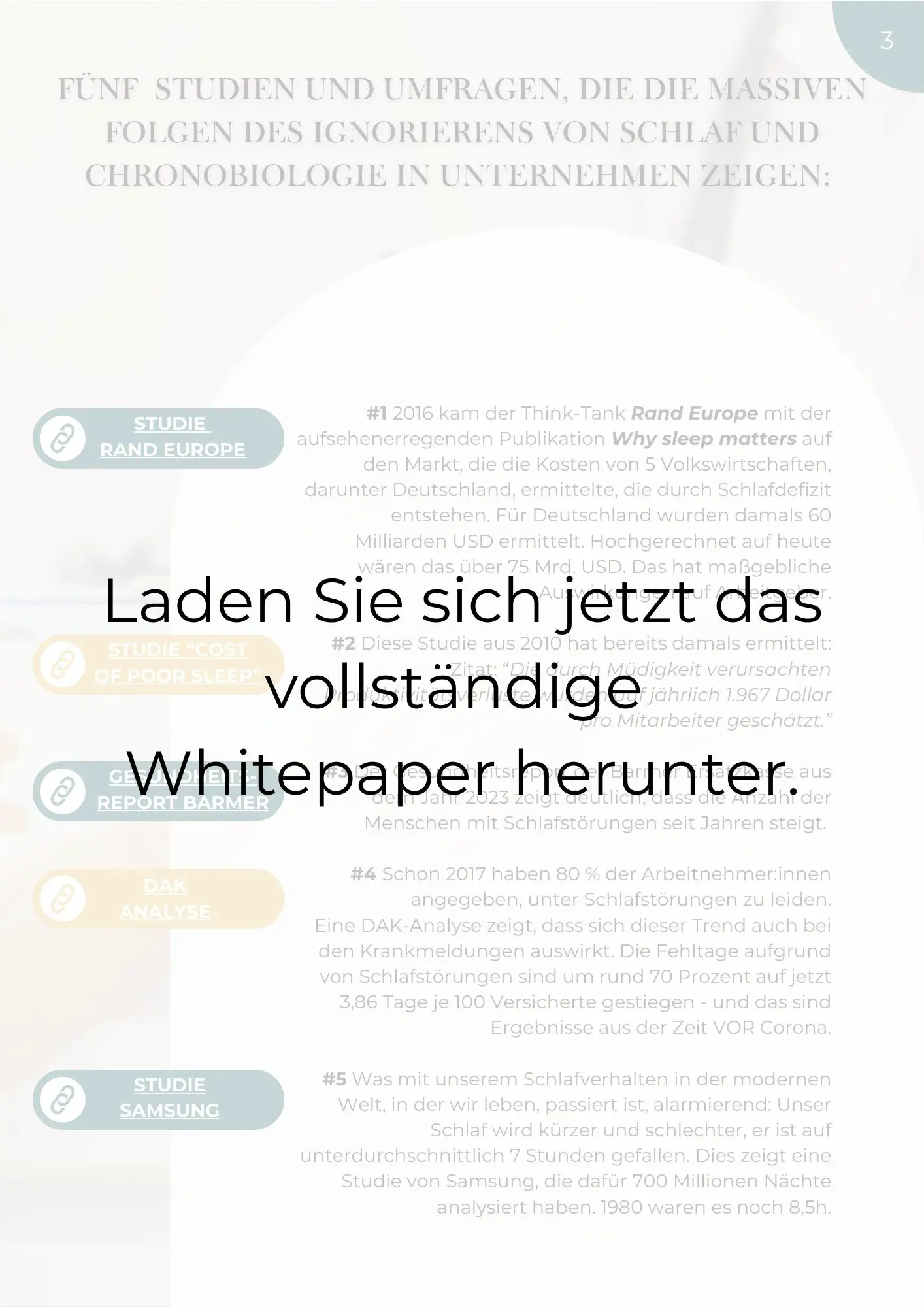
If you are interested in the future of workplace safety and would like to take a closer look at the possible connection between working hours, biological rhythms, and risk assessment, I cordially invite you to download the position paper and join this discussion. I would be delighted if you would reach out to me regarding my more than 20 years of expertise gained from scientifically supported projects in the field of chronobiology in human resources management. Feel free to review our white paper, “ChronoWorking,” developed in collaboration with the Sleepmaster Academy, beforehand.
1. Slider Version


2. Download
PDF Download: Chronobiological Safety Compliance – A Position Paper on the Integration of Chronobiological Aspects into Occupational Risk Assessments.
In addition to the position paper: The ChronoWorking White Paper
Everything about our scientifically monitored ChronoWorking pilot projects, including all measures and their results.