My story – My vision
Michael Wieden
“The most intelligent systems of the future could be those that take the biological reality of humans into account.”
My professional career originally began in a completely different environment – weapons. Sounds strange, but weapons were my professional focus for 12 years at the largest German trading company for hunting and sporting weapons. Perhaps this distance from traditional health or scientific structures was one of the reasons why I began to look at human performance differently.
In 2002, I wanted to get out of this environment and took part in one of the first remote training courses in Germany – at that time still via satellite from home or occasionally from a small café near Marbella on the Costa del Sol. At the time, it was almost futuristic.
However, the first week of the training still took place in a traditional seminar room in Würzburg/Germany. In order to get to know the participants better, the lecturer divided the group into several teams. Our task:
Develops a new time management system.
We had 15 minutes, and while most of the groups were thinking about technical solutions, processes and organization, I spontaneously had a completely different thought:
“Why is time management not actually based on people’s performance?“
Our group developed a short pitch from this idea within a few minutes. When we presented it, the participants and the lecturer reacted with unexpected enthusiasm. One sentence from the lecturer has stayed with me to this day:
“You absolutely have to stay on top of this topic.”
Without knowing it at the time, these 15 minutes were probably my first conscious contact with the science of chronobiology, which would gradually become the center of my work from that day on.
INQA – New Quality of Work Initiative
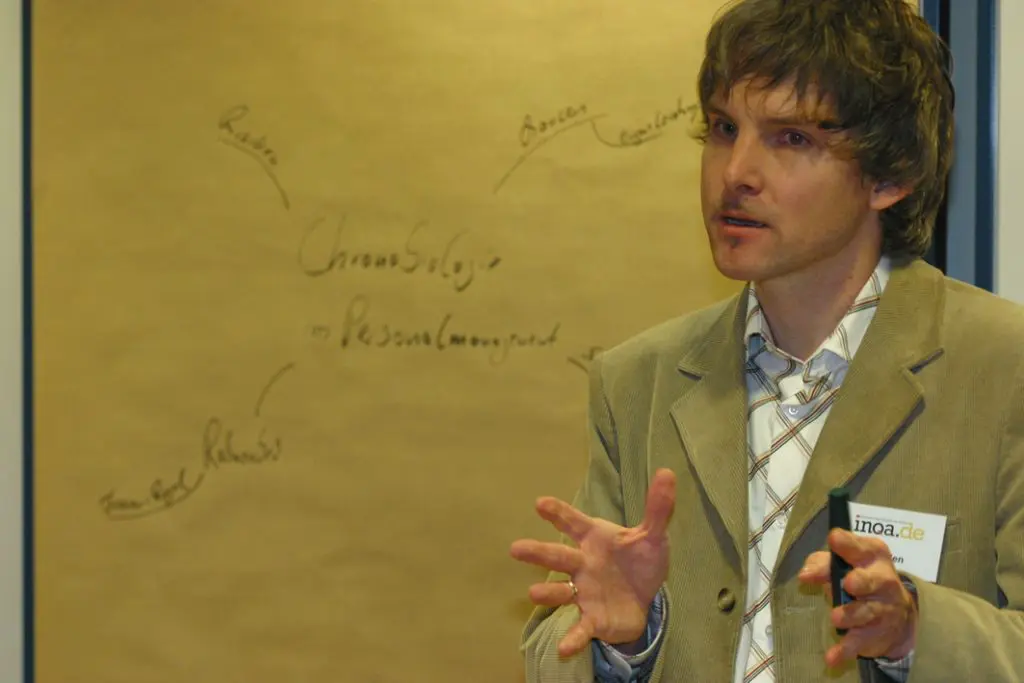
Six months later, I attended an event organized by the New Quality of Work Initiative (INQA) with decision-makers from politics and business. In the evening, participants were able to spontaneously post topics for small open-space workshops the next day on a pinboard.
I wrote a note entitled “Chronobiology in HR management” and put it up on the pinboard. Although the topic was completely unknown at the time, by the end of the evening there were ten names on it. I held the workshop spontaneously without any preparation, and again everyone was enthusiastic about the approach. At the end, one participant came up to me and said:
“It opens a thousand windows.”
These two sentences have accompanied me and my work to this day … incidentally, also the work of this participant, with whom I am still in contact today.
Relevance
We look at many of today’s problems in isolation, although they are often an expression of a deeper conflict between human biology and modern systems.
Here I would like to come back to my words on the homepage. The more digital and complex our world becomes, the more many people lose their natural point of reference.
Systems, technologies and social structures are increasingly setting the pace, while the biological reality of the human being often becomes a negotiable mass.
At the same time, the question of identity and orientation grows with increasing diversity. Perhaps a central part of this answer does not lie exclusively in social roles or external attributions, but deep within human nature itself.
For me, therefore, the future does not lie in the permanent optimization of human beings, but in the more intelligent combination of biological potential and social development into a common evolution.
Because where people can live and work more in harmony with their natural abilities, rhythms and potential, something often arises that cannot be generated artificially:
intrinsic enthusiasm.
Only intelligent questions lead to intelligent answers
From these early moments and the resulting realization, my books, training courses, lectures, international projects and finally concepts such as getting up without an alarm clock, ChronoClinic, COPEP or ChronoCity developed around the topic of “ChronoWorking”.
The actual origin was never a business plan, but a simple question:
“What would happen if we started to align systems more closely with human biology and its enormous potential, instead of permanently adapting humans to purely temporal systems?“
I have been providing answers since 2002.